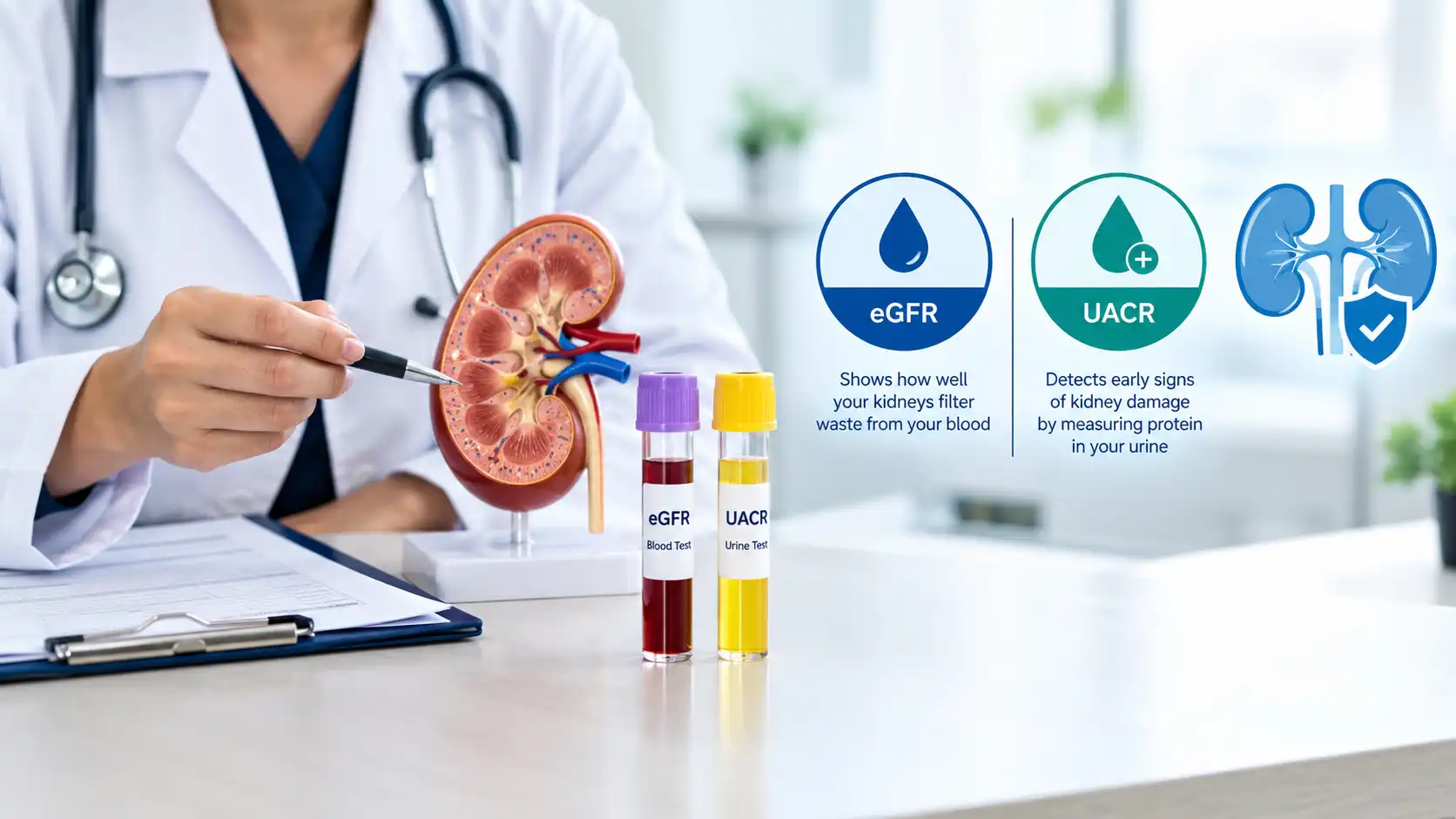

Most people with diabetes or high blood pressure get a kidney number on their yearly labs. That number is usually eGFR. Far fewer get the second test that catches kidney damage years earlier: the urine albumin to creatinine ratio, or UACR.
That gap is real. Federal data from 2023 show only about 56 percent of Medicare patients with diabetes nationwide received an annual urine albumin test. Among American Indian and Alaska Native Medicare patients with diabetes, the rate was under 30 percent.
So here is the short version. eGFR tells you how well your kidneys filter. UACR tells you whether your kidneys are leaking. You need both to know where you stand. For a wider overview of the full panel, see our guide to kidney function tests.
What eGFR Measures
Estimated glomerular filtration rate is calculated from a blood creatinine level, plus your age and sex. Creatinine is a waste product from muscle. When kidneys slow down, creatinine builds up and eGFR falls. Labs in the United States now use the 2021 CKD-EPI equation, which no longer includes race. For a deeper look at the creatinine side, see how creatinine levels indicate kidney function.
| eGFR (mL/min/1.73m²) | Category | Meaning |
| 90 or higher | G1 | Normal filtration |
| 60 to 89 | G2 | Mildly reduced |
| 45 to 59 | G3a | Mildly to moderately reduced |
| 30 to 44 | G3b | Moderately to severely reduced |
| 15 to 29 | G4 | Severely reduced |
| Below 15 | G5 | Kidney failure |
Where eGFR Falls Short
- It can look normal in early disease, since healthy nephrons pick up the slack
- Muscle mass skews it: bodybuilders can look worse, frail older adults can look better than they are
- Dehydration, heavy meat meals, and creatine supplements can lower it temporarily
When creatinine results do not fit the clinical picture, a cystatin C blood test gives a second estimate that muscle mass affects less. Our article on why eGFR matters for kidney health covers these nuances.
What UACR Measures
UACR compares albumin, a protein, to creatinine in a single urine sample. Healthy kidneys keep albumin in the blood. Damaged filters let it slip through. Albumin in urine is one of the earliest signs of kidney injury from diabetes and high blood pressure, and it often shows up while eGFR still looks fine.
| UACR (mg/g) | Category | Meaning |
| Below 30 | A1 | Normal to mildly increased |
| 30 to 300 | A2 | Moderately increased (formerly “microalbuminuria”) |
| Above 300 | A3 | Severely increased |
Albumin in urine also predicts heart attack and stroke risk, not only kidney risk. Read more in what protein in urine means for your long-term health.
Things That Can Raise UACR Temporarily
- Hard exercise within 24 hours of the test
- Fever, infection, or a urinary tract infection
- Very high blood sugar or blood pressure on the day of testing
- Menstruation
Because of this, one high result is not a diagnosis. Guidelines call for two of three samples to be elevated over 3 to 6 months. A first morning urine sample gives the most reliable reading.
Why Both Tests Together Tell the Real Story
Chronic kidney disease is defined as either an eGFR below 60 or signs of kidney damage such as a UACR of 30 or higher, lasting more than three months. That “or” matters. Someone can have CKD with a perfectly normal eGFR.
Here is a practical example. Patient A has an eGFR of 75 and a UACR of 450. Patient B has an eGFR of 50 and a UACR of 12. Many people would guess Patient B is in more trouble. Under the KDIGO risk grid, Patient A actually sits in a higher risk category for kidney failure and heart events.
The Combined Risk Grid
| eGFR Category | A1 (under 30) | A2 (30 to 300) | A3 (over 300) |
| G1 to G2 (60+) | Low risk | Moderate | High |
| G3a (45 to 59) | Moderate | High | Very high |
| G3b (30 to 44) | High | Very high | Very high |
| G4 to G5 (under 30) | Very high | Very high | Very high |
Your place on this grid shapes how often you need labs, which medicines help, and whether you should see a nephrologist.
Who Should Get Both Tests and How Often
| Your Situation | Suggested Testing |
| Type 2 diabetes | eGFR and UACR at diagnosis, then at least yearly |
| Type 1 diabetes for 5+ years | eGFR and UACR at least yearly |
| High blood pressure | eGFR and UACR at least yearly |
| Family history of kidney failure | Discuss screening schedule with your doctor |
| Existing CKD | 1 to 4 times a year based on your risk grid position |
| Heart failure or prior heart attack | At least yearly |
If you are in any of these groups and your chart only shows eGFR, ask for a UACR at your next visit. It is a simple urine test and is usually covered by insurance.
What Your Results Mean for Treatment
UACR is not just a warning sign. It is also a treatment target. Lowering albuminuria by 30 percent or more is linked with slower kidney decline. Medicines that reduce UACR include:
- ACE inhibitors or ARBs
- SGLT2 inhibitors
- Finerenone for people with type 2 diabetes and albuminuria
- GLP-1 receptor agonists, which have shown kidney benefit in type 2 diabetes
Blood pressure and blood sugar control matter just as much. Our diabetic kidney disease and hypertension management programs both use UACR as a core progress marker.
A Simple Action Plan Based on Your Numbers
- eGFR 60+ and UACR under 30: Keep yearly testing if you have diabetes or high blood pressure.
- eGFR 60+ and UACR 30 to 300: Repeat to confirm, then talk about kidney-protective medicines.
- UACR over 300 at any eGFR: Nephrology referral is recommended.
- eGFR under 30 at any UACR: Nephrology referral is recommended.
- eGFR drop of more than 25 percent with a category change: Contact your doctor soon.
Early changes often come with no symptoms at all. Our guide to early stage kidney disease care options explains what to do before problems become visible.
Local Testing Gaps in Southern Oklahoma
Southern Oklahoma has high rates of diabetes and high blood pressure, and many residents rely on small rural clinics where urine albumin testing is often skipped. Some patients first learn about kidney disease when eGFR has already dropped to stage 3 or 4. Adding a yearly UACR is one of the cheapest, most effective steps a primary care patient can take.
Frequently Asked Questions
Is UACR the same as a urinalysis?
No. A standard urinalysis dipstick is not sensitive enough to catch early albumin leaks. UACR is a separate, quantitative test.
Can my UACR go down?
Yes. Better blood pressure and blood sugar control and certain medicines often lower UACR within months.
My eGFR is normal but my UACR is high. Do I have kidney disease?
If the high UACR is confirmed on repeat testing over three months, yes, that meets the definition of CKD.
What should I bring to a kidney appointment?
Past lab results, a medication list, and home blood pressure readings. Our page on what to expect at your first nephrology visit has a full checklist.
Get Both Numbers Checked and Explained
Our nephrology practice reviews eGFR and UACR trends together for patients in Ardmore, Ada, and Gainesville. If your results show a change or you are unsure what they mean, schedule an appointment or call (580) 223-8614.
This article is for education only and does not replace advice from your own physician.